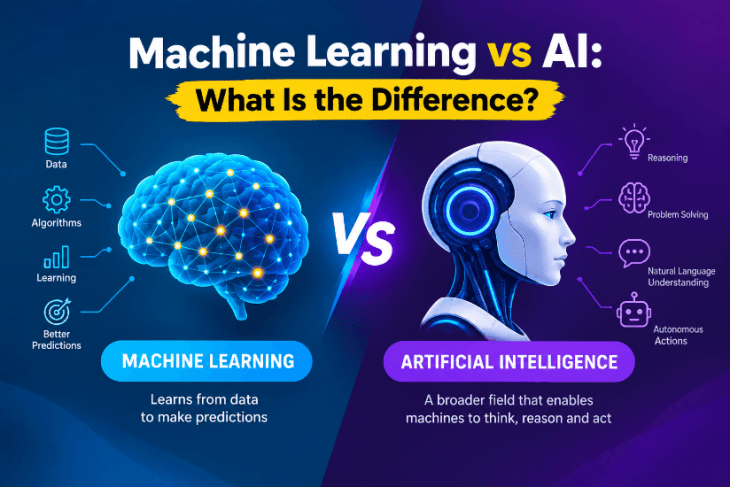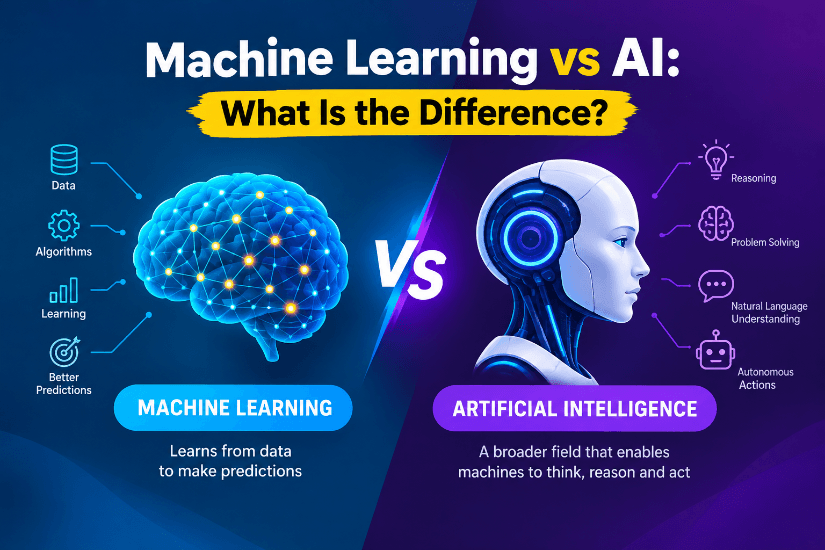
Artificial intelligence (AI) is the broader field of building systems that can perform tasks linked to human intelligence. Machine learning (ML) is a subset of AI that learns patterns from data to make predictions, classifications, recommendations, or decisions. In simple terms, AI is the bigger concept, and machine learning is one of the main ways AI systems learn.
The confusion often starts because modern AI includes much more than machine learning. It can involve natural language processing (NLP), computer vision, robotics, expert systems, deep learning, generative AI, and AI agents.
In this guide, I’ll explain Machine Learning vs AI with simple examples, explore the difference between deep learning and machine learning, compare predictive AI with generative AI, and discuss practical applications in finance, software development, and everyday life. You’ll also learn how these technologies relate to data science and how to choose the right approach for a particular task.
Machine Learning vs AI: What Is the Difference?
Artificial intelligence and machine learning are closely related, but they are not the same thing. AI is the broader field of creating systems that can perform tasks associated with human intelligence. Machine learning is one approach used to build these systems.
What Is Artificial Intelligence?
Artificial intelligence is the field of developing computer systems that can perform tasks such as understanding language, recognizing images, solving problems, making decisions, and planning actions.
An AI system may use machine learning, but it can also rely on predefined rules, logical reasoning, search algorithms, or a combination of methods.
For example, a navigation system may use AI to select a route based on traffic and road conditions. A rule-based system can follow predefined instructions, while a modern AI assistant may use machine learning and generative AI to understand a question and produce a response.
Artificial intelligence is therefore an umbrella term for several technologies and methods that help computers perform intelligent tasks.
What Is Machine Learning?
Machine learning is a way for computers to learn patterns from data instead of relying only on fixed instructions. A model is trained using examples and then applies what it has learned to new information.
For example, a bank can train a machine learning model using historical transactions to identify patterns associated with fraud. When a new transaction arrives, the model estimates whether it looks legitimate or suspicious.
Machine learning is especially useful when a problem involves large amounts of data or patterns that are difficult to describe using manually written rules.
Are AI and Machine Learning the Same Thing?
No. Machine learning is a subset of AI, but not every AI system needs machine learning.
Think of AI as the broader goal of making computers perform intelligent tasks. Machine learning is one way to achieve that goal by allowing computers to learn from data.
Many modern applications combine multiple technologies. A single application might use machine learning to predict customer behavior, NLP to process a message, and generative AI to create a response.
AI vs ML vs Deep Learning vs Generative AI
AI, machine learning, deep learning, and generative AI describe related but different concepts.
The basic relationship is:
Artificial Intelligence → Machine Learning → Deep Learning
Deep learning is a type of machine learning, which is itself a subset of AI. Generative AI is an area of AI focused on creating new content and often relies on deep learning models.
What Is Deep Learning?
Deep learning uses artificial neural networks with multiple layers to learn complex patterns from data. These networks can learn useful representations of information, making them valuable for tasks involving images, speech, language, and video.
For example, a deep learning model can learn to recognize objects in photographs by training on many labeled images. Deep learning also powers many modern speech recognition and language-model applications.
Deep Learning vs Machine Learning: Key Differences
The main difference in deep learning vs machine learning is that deep learning uses multi-layer neural networks, while traditional machine learning includes a wider range of algorithms, such as regression, decision trees, and other methods.
Traditional machine learning often works well with structured data, such as customer records or sales figures. It may require people to choose or prepare important features before training a model.
Deep learning can learn complex features automatically, but it often requires more data, computing power, and training time.
For example, a traditional ML model might use selected transaction features to detect possible fraud. A deep learning model may identify more complex patterns across a large volume of transaction data.
Neither approach is always better. The right choice depends on the problem, available data, computing resources, and performance requirements.
Where Does Generative AI Fit?
Generative AI creates new content based on a prompt, instructions, or other input. It can produce text, images, audio, video, software code, and other digital content.
Many generative AI tools use foundation models trained on large datasets. Large language models (LLMs), which generate and process language, are one example.
Generative AI is not a replacement for machine learning. Instead, it is an application area that often uses machine learning and deep learning to create new outputs.
What Are Non-Generative AI Examples?
Non-generative AI refers to systems that analyze information, recognize patterns, make predictions, classify data, or recommend actions without generating new content as their primary task.
Common non-generative AI examples include fraud detection, spam filtering, credit-risk assessment, demand forecasting, predictive maintenance, and product recommendations.
For example, a bank may use machine learning to flag suspicious transactions. An email service may classify unwanted messages as spam, while a streaming platform may recommend movies based on a user’s viewing history.
In healthcare, AI systems can help classify medical images or flag patterns for qualified professionals to review.
Why Does Non-Generative AI Matter?
Generative AI receives much of the attention today, but many practical AI applications focus on prediction and decision support.
Generative AI often answers questions like “What can I create?” Non-generative AI is more likely to answer, “What is likely to happen?” or “Which item should the system recommend?”
If a business needs to forecast sales, detect fraud, or predict customer churn, predictive machine learning may be more suitable than a generative AI tool.
Generative AI vs Predictive AI: What Is the Difference?
Generative AI and predictive AI can both use machine learning, but they solve different problems.
Predictive AI analyzes existing data to estimate likely outcomes. Generative AI uses learned patterns to create new content.
The simplest distinction is this: predictive AI estimates an outcome, while generative AI produces content.
What Does Predictive AI Do?
Predictive AI uses historical and current data to estimate future or unknown outcomes. It can forecast sales, identify suspicious transactions, estimate credit risk, predict customer churn, or detect unusual behavior.
For example, a retailer may use historical sales, seasonal trends, and customer activity to estimate how many products it will sell next month.
This type of system is closely connected to machine learning, statistics, and predictive analytics.
What Does Generative AI Do?
Generative AI creates new content from prompts or other inputs. A marketer might use it to draft product descriptions, while a developer might ask it to generate a code example or explain an error.
Generative AI can also summarize documents, translate text, brainstorm ideas, and transform existing information into a different format.
A Simple Business Example
Consider an online clothing store.
Predictive AI: The store estimates which products will sell best next week by analyzing previous sales and customer behavior.
Generative AI: The store uses an AI tool to draft product descriptions for its upcoming collection.
Both technologies can support the same business, but they perform different jobs. Predictive AI estimates what may happen, while generative AI creates content that helps the business act on information.
How Does Machine Learning Work?
Machine learning allows computers to learn patterns from data and apply those patterns to new situations. A typical project involves collecting data, training a model, testing its performance, and monitoring its results after deployment.
Step 1: Collect Data
A machine learning project starts with relevant data. This could include sales figures, customer records, photographs, emails, audio, or other information.
The data may be structured, such as information stored in a spreadsheet, or unstructured, such as written documents and images.
Data quality matters. Incomplete, outdated, or biased information can lead to unreliable predictions.
Step 2: Train the Model
During training, an algorithm learns patterns that connect input information to a desired result.
For example, a retailer could provide historical sales data alongside product prices, seasons, and promotions. The model learns how these factors relate to sales and uses those patterns to estimate future demand.
A useful model should perform well on data it has not seen before, rather than simply memorizing its training examples.
Step 3: Test the Model
After training, the model is evaluated using separate data. The right evaluation metric depends on the task.
Accuracy may be useful for some classification problems, while precision, recall, or prediction error may be more appropriate for others.
A fraud detection system, for example, must balance the need to catch suspicious transactions against the risk of incorrectly flagging legitimate purchases.
Step 4: Make Predictions
Once the model performs well enough, it can process new information. This stage is called inference.
A trained model might estimate whether a transaction is suspicious or predict which products a customer may prefer.
Step 5: Monitor and Improve
Machine learning models can become less accurate as real-world conditions change. This is known as model drift.
For example, customer behavior and fraud patterns may change over time. Teams need to monitor results, evaluate new data, and update models when necessary.
Statistical Learning vs Machine Learning: What Is the Difference?
Statistical learning and machine learning overlap significantly, but they often emphasize different goals.
Statistical learning traditionally focuses on understanding relationships between variables, estimating effects, measuring uncertainty, and making predictions. Machine learning often places greater emphasis on learning patterns that generalize well to new data.
What Is Statistical Learning?
Statistical learning uses statistical methods to understand data and identify relationships between variables.
For example, a business might use a statistical model to examine the relationship between advertising spending and sales. The model could estimate how sales change as advertising spending increases, along with the uncertainty around that estimate.
What Is Machine Learning?
Machine learning focuses on algorithms that learn patterns from data and apply them to new examples.
A business might use a machine learning model to predict which customers are likely to cancel a subscription. The goal may be to produce accurate predictions rather than explain every relationship in the data.
Is Statistical Learning Part of Machine Learning?
The boundary between statistical learning and machine learning is not strict. Both fields use methods like regression, decision trees, and other predictive techniques.
A useful way to understand statistical learning vs machine learning is that statistical learning often emphasizes interpretation and uncertainty, while machine learning often emphasizes predictive performance and generalization. In practice, the two approaches frequently work together.
Real-World Examples of AI and Machine Learning
AI and machine learning can predict outcomes, recognize patterns, recommend products, and generate content. The technology used varies by task.
AI That Predicts
Businesses use AI to forecast sales, estimate demand, identify possible fraud, and predict customer churn.
For example, an online store may analyze previous orders and seasonal trends to estimate next month’s sales. This is a prediction task rather than a content-generation task.
AI That Recognizes
AI systems can recognize patterns in images, text, audio, and video.
Computer vision models can identify objects in photographs, speech recognition systems can convert spoken words into text, and email filters can classify unwanted messages.
AI That Recommends
Recommendation systems use information about user behavior and preferences to suggest relevant products, videos, music, or search results.
Machine learning can identify patterns in viewing or purchasing activity and use those patterns to rank recommendations.
AI That Generates
Generative AI produces new content, including articles, summaries, presentations, images, and code.
For example, a content creator may use an AI tool to prepare a first draft, while a developer may use it to generate a basic function. The output still needs human review for accuracy, quality, and suitability.
These examples show why AI and machine learning are not competing technologies. One application can combine prediction, recommendation, language processing, and content generation.
How Is Machine Learning Used in Finance?
Machine learning in finance helps organizations analyze financial data and identify patterns that support predictions, alerts, and recommendations.
Fraud Detection
Banks can train models on historical transactions to identify patterns associated with fraud. A model may flag an unusual purchase for additional review.
However, a suspicious transaction is not automatically fraudulent. Human review and other safeguards can help reduce false alarms.
Credit Risk
Lenders may use machine learning to estimate the likelihood that a borrower will have difficulty repaying a loan.
Models can consider relevant financial information, but their results can be affected by data quality, bias, and changing economic conditions.
Market Analysis
Financial firms may use machine learning to analyze market data and support trading strategies. However, these models cannot predict financial markets with certainty. Unexpected events and changing investor behavior can make historical patterns unreliable.
Customer Personalization
Financial companies can use machine learning to identify customer needs and provide more relevant recommendations.
In my view, the strongest use of machine learning in finance is to support better decisions, not remove human responsibility. Important financial decisions still require appropriate oversight, monitoring, and checks for bias.
What Is the Difference Between AI and Machine Learning in Everyday Apps?
You may use AI and machine learning several times a day without realizing it.
An email spam filter may use machine learning to classify messages. A streaming service may predict which shows you will enjoy, while a modern chatbot may combine language processing and generative AI to respond to questions.
Voice assistants can combine speech recognition, NLP, machine learning, and generative models. Each technology handles a different part of the process.
This is why the label “AI-powered” does not tell you everything about an application. It is more useful to understand what the system does, how it works, and whether it performs that task reliably.
Natural Language Processing vs Generative AI
Natural language processing (NLP) is the field of helping computers work with human language. Generative AI focuses on creating new content, including language.
What Is Natural Language Processing?
NLP supports tasks such as translation, sentiment analysis, text classification, information extraction, and speech-related applications.
For example, an email service may classify messages based on their content, while a translation system converts text from one language into another.
What Is Generative AI?
Generative AI creates new content from prompts and context. Language models can draft emails, summarize reports, explain concepts, and produce code.
Is ChatGPT NLP or Generative AI?
ChatGPT is a generative AI application built using modern machine learning and language-model technology. NLP is the broader field of techniques used to process and work with human language.
The two terms are not alternatives. NLP describes a field of language-related methods, while generative AI describes a content-generation capability.
What Would Be an Appropriate Task for Using Generative AI?
Use generative AI when you need to create, transform, or summarize content rather than simply predict a number or classify a record.
Good Tasks for Generative AI
Generative AI can help with writing first drafts, brainstorming ideas, summarizing documents, translating text, preparing presentations, and coding assistance.
A student might use it to summarize a long reading, a marketer might brainstorm campaign ideas, and a small business owner might draft customer emails.
The output should still be checked before it is used, particularly when factual accuracy or sensitive information matters.
Tasks Better Suited to Predictive Machine Learning
Predictive machine learning is generally better suited to tasks that depend on historical data and measurable outcomes.
Examples include forecasting sales, identifying suspicious transactions, estimating credit risk, predicting customer churn, and ranking products based on user behavior.
When Should Humans Remain Involved?
Medical, financial, legal, employment, and safety-critical decisions require appropriate safeguards and human oversight.
A useful rule I follow is simple: let AI support work it can handle safely, but keep people responsible for decisions where errors could seriously affect someone’s health, money, rights, job, or safety.
Generative AI Software Development vs Traditional Machine Learning
Machine learning and generative AI can both support software applications, but they usually solve different problems.
Traditional machine learning learns patterns from data to make predictions, classifications, and recommendations. Generative AI software development tools can create code, explain errors, suggest fixes, and draft test cases from natural-language instructions.
What Is Natural-Language Programming?
Natural-language programming describes the process of expressing software requirements in ordinary language and using an AI system to translate those instructions into code, queries, or workflows.
For example, a developer might ask an AI tool to create a form that collects a customer’s name and email address and saves the information to a spreadsheet.
The tool may generate a starting implementation, but a developer must still review the code, test its behavior, and check for security issues. Natural language can make development more accessible, but it does not remove the need for software engineering.
AI and Problem Solving: Can AI Actually Think?
Artificial intelligence and problem solving are closely connected because AI systems can analyze information, identify patterns, compare options, and produce outputs or actions.
For example, a customer support system might analyze a question, retrieve relevant information, and provide an answer or send the issue to a human agent.
AI problem solving can be summarized as:
Input → Model or reasoning → Output or action
The exact process varies by system. A machine learning model may predict an outcome, while a generative AI system may create an explanation or response.
AI systems can make reasoning errors and generate incorrect information. I treat AI-generated answers as useful starting points rather than automatically correct conclusions, especially when important decisions are involved.
AI can perform useful problem-solving tasks without necessarily having human-like understanding, awareness, or consciousness.
AI vs Machine Learning vs Data Science
AI, machine learning, and data science overlap, but they serve different purposes.
AI focuses on systems that perform intelligent tasks. Machine learning helps systems learn patterns from data. Data science focuses on turning data into useful insights, predictions, and decisions.
Data Analyst vs Data Scientist
The difference between a data analyst and data scientist usually comes down to the problems they solve and the methods they use.
| Role | Main focus |
| Data analyst | Examines existing data, identifies trends, and communicates insights |
| Data scientist | Uses statistics, experiments, and predictive models to solve complex problems |
| ML engineer | Deploys and maintains machine learning models |
| AI engineer | Builds applications using AI models, tools, and systems |
These roles can overlap, and responsibilities vary between companies.
If you enjoy analyzing trends and creating reports, data analytics may be a good starting point. If you prefer statistics, experimentation, and predictive modeling, data science or machine learning may be a better fit.
AI, ML, Deep Learning, and Generative AI: Comparison Table
| Technology | Main purpose | Typical output | Example |
| AI | Perform intelligent tasks | Decisions or actions | Route planning |
| Machine learning | Learn patterns from data | Predictions or classifications | Fraud detection |
| Deep learning | Learn complex patterns | Predictions or generated content | Image recognition |
| Predictive AI | Estimate likely outcomes | Forecasts or probabilities | Sales forecasting |
| Generative AI | Create new content | Text, images, code, audio, or video | AI writing assistant |
These categories can overlap. Deep learning can support predictive and generative tasks, while broader AI applications can combine several methods.
The task matters more than the label. Use predictive machine learning to estimate demand, generative AI to draft content, and a combination of technologies when an application needs to perform several types of work.
Machine Learning vs AI: Which One Should You Use?
There is no single winner in the Machine Learning vs AI comparison. The right technology depends on the problem you need to solve.
- Need to predict something? Consider machine learning or predictive AI when you have relevant data and want to estimate an outcome.
- Need to generate something? Consider generative AI for writing, summarizing, creating images, or generating code.
- Need to recognize or classify something? Machine learning, deep learning, computer vision, or NLP may be appropriate.
- Need to plan and execute several actions? Consider AI agents when the system needs to use tools and complete connected steps.
- Need several capabilities? A broader AI application may combine prediction, recognition, content generation, and automation.
Before selecting a technology, ask what the system needs to do, which data is available, what result is expected, and how its performance will be evaluated.
Common Misconceptions About AI and Machine Learning
AI and ML Are the Same Thing
No. AI is the broader field, while machine learning is one approach to building AI systems.
All AI Uses Machine Learning
Not necessarily. AI can use predefined rules, logic, search, planning, machine learning, or a combination of methods.
Generative AI Is All of AI
No. AI also includes prediction, classification, recommendations, computer vision, robotics, and other applications.
Machine Learning Always Predicts the Future
Machine learning can also classify data, detect anomalies, rank results, recommend products, and recognize patterns.
More Data Always Makes a Model Better
More data can help, but its quality and relevance matter. Biased, outdated, or poorly labeled data can lead to unreliable results.
AI Outputs Are Always Accurate
AI systems can make incorrect predictions and generate false information. Models need testing, monitoring, and appropriate human review.
The Limitations of AI and Machine Learning
AI and machine learning are useful, but their results depend on data quality, model design, system instructions, and real-world conditions.
Poor-quality or biased data can lead to unreliable outcomes. Model drift can reduce performance when patterns change. Generative AI can also produce convincing but incorrect information, while predictive systems can generate false positives and false negatives.
Privacy, security, explainability, and computing costs are other important considerations. Organizations need to evaluate how data is collected and used, how systems are tested, and what safeguards are necessary.
The NIST AI Risk Management Framework provides guidance for identifying and managing AI-related risks.
In my view, choosing an AI system should involve four questions: What problem are we solving? How will success be measured? What could go wrong? Where does a person need to review the result?
What Does the Future of AI and Machine Learning Look Like?
Multimodal and Agentic AI
AI systems are increasingly able to work with text, images, audio, video, and other forms of information. AI agents are also being developed to plan steps, use tools, and complete tasks with less direct input.
However, practical deployment still varies by organization and task.
Smaller, Specialized Models
Smaller models built for specific purposes can offer lower costs, faster responses, and greater control. Not every application needs the largest available model.
AI-Assisted Software Development
Generative AI can assist with code generation, debugging, testing, and documentation. I expect its most useful applications to be those where developers can save time on routine tasks while reviewing and testing the output.
AI and Traditional Machine Learning Will Work Together
Generative AI will not make traditional machine learning unnecessary. A business might use machine learning to forecast demand, another model to detect fraud, and generative AI to summarize the results.
The Stanford AI Index tracks developments in AI research, investment, adoption, and deployment. Its findings are useful for following changes in the field, although statistics should always be checked against the relevant report year.
Human-AI Collaboration Will Matter
For me, the most useful question is not whether AI will replace people. It is which tasks AI can handle well, which tasks still need human judgment, and how people can use these systems safely and efficiently.
Frequently Asked Questions About Machine Learning vs AI
What Is the Difference Between AI and Machine Learning?
AI is the broader field of creating systems that perform tasks associated with human intelligence. Machine learning is a subset of AI that learns patterns from data to make predictions, classifications, recommendations, and other decisions.
Is Machine Learning a Subset of Artificial Intelligence?
Yes. Machine learning is one approach used to build AI systems. AI can also rely on rules, logic, search, planning, and other techniques.
Is AI Better Than Machine Learning?
Neither is inherently better. AI is the broader field, while machine learning is a method within it. The right choice depends on whether the task involves prediction, content generation, recognition, or a combination of capabilities.
What Is the Difference Between Machine Learning and Deep Learning?
Deep learning is a type of machine learning that uses neural networks with multiple layers. Traditional ML includes other methods and can work well with structured data, while deep learning is especially useful for complex data such as images, speech, and language.
Is Generative AI a Type of Machine Learning?
Yes. Generative AI commonly uses machine learning, particularly deep learning and foundation models, to create content such as text, images, audio, video, and code.
What Are Examples of Non-Generative AI?
Examples include fraud detection, spam filtering, credit-risk scoring, sales forecasting, product recommendations, customer churn prediction, anomaly detection, and predictive maintenance.
Is ChatGPT AI or Machine Learning?
ChatGPT is a generative AI application built using modern machine learning and language-model technology. Machine learning describes part of the technology behind it, while generative AI describes its content-generation capability.
What Is the Difference Between Generative AI and Predictive AI?
Generative AI creates new content, while predictive AI estimates likely outcomes. A business might use predictive AI to forecast demand and generative AI to create product descriptions.
What Is the Difference Between NLP and Generative AI?
Natural language processing helps computers work with human language through tasks such as translation, classification, and information extraction. Generative AI creates new content and can use language models to generate responses, summaries, and other text.
What Is Machine Learning Used for in Finance?
Machine learning in finance can support fraud detection, credit-risk assessment, market analysis, forecasting, and customer personalization. These applications require monitoring and appropriate oversight.
What Is the Difference Between a Data Analyst and a Data Scientist?
A data analyst typically examines existing data and communicates insights. A data scientist may also build statistical or machine learning models, run experiments, and solve more complex data problems. Responsibilities vary by organization.
Should I Learn AI or Machine Learning First?
Start with AI fundamentals if you are new to the subject. Learn about machine learning if you want to build models or work with data. If your goal is to use existing AI tools, you may not need advanced machine learning knowledge.
Final Verdict: Machine Learning vs AI
AI is the broader field, and machine learning is one of its most important approaches. Deep learning is a subset of machine learning, while generative AI focuses on creating content and predictive AI focuses on estimating likely outcomes.
If you need to predict, consider machine learning or predictive AI. If you need to generate, generative AI may be a better fit. If you need to recognize or classify information, machine learning, deep learning, computer vision, or NLP may be appropriate. More complex applications can combine several technologies.
The main lesson from comparing Machine Learning vs AI is that these technologies are not competing choices. They can collaborate within the same application.
Before choosing a tool, start with the task, the data available, the result you need, and the level of human oversight required. This approach is more useful than choosing a technology simply because it is newer or more popular.
Ready to put AI into practice? Explore more practical technology guides on Techno Blazze to discover ways AI tools can support your learning, productivity, and everyday work.